
Simple Yoga Stretches for Improving Flexibility After Long Working Hours
At the end of an eight- or nine-hour workday spent tethered to a desk, standing up often feels like unfolding an accordion that has rusted shut. Your neck feels compressed, your shoulders are pinned toward your ears, your lower back aches with a dull, throb-like stiffness, and your hips seem permanently locked at a ninety-degree angle. Even if you maintain an ergonomic workstation, the simple reality of prolonged sitting places a steady, compressive load on the human frame.
The human body is an adaptable machine that takes the shape of whatever position it occupies most frequently. When you spend the bulk of your waking hours folded into an office chair, your soft tissues undergo adaptive shortening.
Many professionals attempt to counter this evening rigidity with aggressive, fast-paced workouts or intense stretching routines, only to find their joints irritated and their lower back further strained. When your nervous system and musculature are exhausted from a long workday, aggressive force is the wrong prescription.
Restoring functional flexibility requires gentle, deliberate movements that downregulate workday stress, hydrate dried-out fascial layers, and open the specific anatomical zones compromised by modern desk work.
The Biomechanics of Desk Fatigue: Why Modern Work Stiffens Us
To stretch effectively, you have to understand the specific postural imbalances created by computer work. Sitting in a chair creates a distinct mechanical pattern throughout the kinetic chain:
-
Shortened Hip Flexors: The psoas and rectus femoris remain in a shortened position for hours. Over time, these muscles pull forward on the pelvis, creating anterior pelvic tilt and placing chronic shear stress across the lumbar spine.
-
Inhibited Gluteal Muscles: Sitting directly compresses the gluteus maximus, essentially shutting down communication between the brain and your body’s primary hip extensors. When glutes fall asleep, the hamstrings and lower back are forced to take on double duty.
-
Thoracic Kyphosis and Forward Head Posture: Leaning toward a monitor rounds the upper back, compresses the rib cage, and forces the cervical spine to crane forward. For every inch your head drifts in front of your shoulders, the workload on your neck and upper back muscles doubles.
When you finish your workday, your tissues are not simply tight; they are cold and neurologically guarded. Forcing cold muscles into deep, competitive yoga postures triggers the myotatic stretch reflex—a defensive biological mechanism where the muscle contracts to protect itself from tearing.
A successful evening sequence avoids sudden, bouncing movements, relying instead on passive, supported postures held with steady diaphragmatic breathing.
Foundational Stretches for the Upper Body and Neck
Opening the chest and thoracic spine restores natural posture, frees up restricted breathing, and immediately releases the tension headache triggers that build behind the eyes.
Extended Puppy Pose (Uttana Shishosana)
Puppy pose is one of the most effective tools for reversing the hunched computer slouch. It provides the deep shoulder opening of Downward-Facing Dog without demanding energy or lower-body stability.
Begin on your hands and knees in a tabletop position, with hips stacked directly over knees. Keeping your hips elevated over your knees, slowly walk your hands forward toward the top of your mat. Allow your chest to sink toward the floor while resting your forehead on the mat or on a yoga block.
Focus on actively drawing the armpits toward the ground while keeping your lower ribs drawn slightly inward to prevent hyperextending the lower back. Hold this shape for eight to ten slow, smooth breaths. This posture gently decompresses the thoracic vertebrae, lengthens the latissimus dorsi, and opens tight pectoral muscles.
Thread the Needle (Parsva Balasana)
Typing and mouse work restrict rotational mobility through the mid-back, transferring strain directly into the neck and lumbar spine. Thread the Needle introduces gentle, passive rotation to release the deep muscles between the shoulder blades.
From tabletop, inhale and lift your right arm out to the side, then exhale and sweep the right arm under your chest, resting your right shoulder and right temple on the floor. Keep your hips level and centered over your knees. You can leave your left hand pressed into the mat for stability or extend it toward the top edge of your space.
Breathe into the back of your right rib cage, feeling the rhomboids and rear deltoids expand with every inhalation. After thirty to forty-five seconds, press through the left hand, return to tabletop, and repeat on the opposite side.
Opening the Hips and Lower Back Safely
Unlocking the hips removes the downward tension that constantly tugs on your lumbar spine, allowing your pelvis to return to a neutral, painless baseline.
Low Lunge with a Pelvic Tuck (Anjaneyasana)
Most people perform low lunges incorrectly after work by sagging their hips as far forward as possible, dumping compressive force into the lower spine. To target the deep psoas muscle safely, you must prioritize pelvic alignment over forward depth.
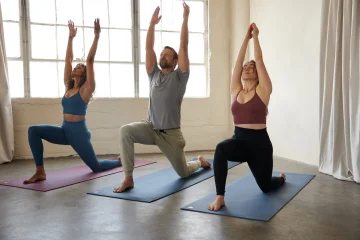
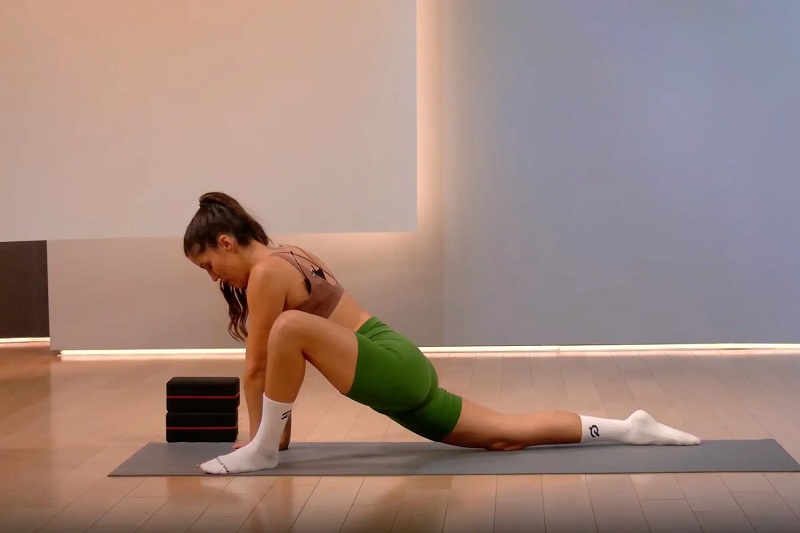
From a kneeling position, step your right foot forward so your ankle sits directly under your knee. Place your hands on your front thigh or on blocks alongside your hips. Before moving forward, tuck your tailbone underneath you, gently drawing your pubic bone toward your belly button.
Maintaining this subtle posterior pelvic tilt, ease your hips forward only a few inches until you feel a clean, focused stretch across the front of your left hip and thigh. Avoid collapsing into a deep backbend; keeping your torso upright and your pelvis tucked isolates the hip flexors while protecting your lower back. Hold for five to seven deep breaths before switching sides.
Reclined Figure-Four (Supta Kapotasana)
Traditional Pigeon Pose places heavy torsional stress across the knee joint, which can be risky after sitting all day with stiff ligaments. The reclined figure-four delivers all the hip-opening benefits of Pigeon while keeping your spine flat, relaxed, and fully supported by the floor.
Lie flat on your back with knees bent and feet resting on the floor. Cross your right ankle over your left thigh just below the knee, flexing your right foot to protect the ankle joint. Reach your hands around your left hamstring, gently drawing your left knee toward your chest while keeping your head and shoulder blades flat against the ground.
Use your right elbow to gently guide the right knee away from your torso. You should feel a deep, satisfying release through the right outer hip and piriformis. Breathe slowly into the lower abdomen for sixty seconds, then switch legs.
Decompressing the Lower Body with Restorative Holds
The final phase of an evening stretch routine should restore circulation, flush stagnant fluid from the lower limbs, and transition your nervous system from the demands of work into evening rest.
Supported Bridge Pose (Setu Bandha Sarvangasana)
Supported Bridge gently extends the hips and expands the chest with zero muscular strain, making it an ideal passive remedy for desk fatigue.
Lie on your back with knees bent and feet flat on the floor, hip-width apart, close enough that your fingertips can brush your heels. Press down through your feet to lift your hips, and slide a yoga block (or a firm stack of folded blankets) directly beneath your sacrum—the flat, bony plate at the base of your spine.
Lower your hips onto the support and let your arms rest by your sides, palms turned upward. Allow your entire body weight to settle completely into the block. This posture passively opens the hip flexors, expands the lungs, and decompresses the lower abdominal organs without requiring core activation. Remain here for two to three minutes.
Legs-Up-the-Wall (Viparita Karani)
If you only have time for a single posture after a grueling workday, choose this one. Sitting causes venous blood and lymphatic fluid to pool in the lower legs and ankles. Elevating the legs reverses that gravitational burden, assisting venous return to the heart and gently stretching tight hamstrings.
Bring your hips close to an open wall, turn onto your back, and extend your legs straight up the wall so your body forms an L-shape. You can keep a small gap between your hips and the wall if your hamstrings feel tight, or place a thin folded blanket beneath your pelvis for elevation. Rest your arms wide with palms up, close your eyes, and allow your natural breathing rhythm to slow. Stay in this inversion for three to five minutes, letting the floor support your entire skeletal structure.
Setting Up for an Effective Post-Work Practice
The success of an evening yoga routine relies just as much on psychological boundaries as it does on physical alignment.
Avoid bringing your laptop, work smartphone, or digital notifications into the space where you stretch. If your eyes are tracking incoming emails while you perform a low lunge, your nervous system remains trapped in a sympathetic fight-or-flight state, keeping your muscle fibers tense and resistant to lengthening.
Dim the overhead lighting, step out of restrictive work clothing into loose layers, and let your exhalations become slightly longer than your inhalations. A ten- to fifteen-minute investment in these simple physical shapes does more than loosen tight muscles; it establishes a clear, restorative threshold between your professional duties and your personal life, leaving you feeling grounded, agile, and comfortable in your body for the rest of the evening.